Bustard Head, Queensland, Australia: lighthouse keeper's cottage
George and Margaret Goodfellow lived at Bustard Head from 1886 to 1889; an isolated interlude for town folk whose grandmothers were school teachers, embroidery merchants and wives of a druggist, painter, organist, soldiers and farmers.
Showing posts with label Glastonbury. Show all posts

Henry Goodfellow and Grace Fitzpatrick in Somerset


Henry Tewksbury Goodfellow’s parents were John, a house painter and organist and Jane Jeanes, a school mistress.  

Henry was baptised on 17 July 1825 in Wincanton.  Henry’s name was recorded as Henry Robert Goodfellow, occupation, surgeon, on his son George Henry's marriage certificate and Robert Goodfellow on George’s death certificate.


Grace Fitzpatrick’s parents were John Fitzpatrick and Jane Howe.  They were married in London in 1820.  Grace was born on 4 March 1823. In the Census records, Grace’s birthplace is consistently recorded as France, or “F” [foreign] and in 1901 on the Family Search index, her birthplace is recorded as Boulogne, Picardie, France.  At last, this confirms she was born in Boulogne-sur-Mer, on the west coast, close to the English Channel and possibly born during her father John’s military service in France.

John Fitzpatrick was a Captain in the 88th Regiment of Foot (Connaught Rangers).  This Regiment was active in the French Revolutionary Wars and Napoleonic Wars.


Grace's father, John Fitzpatrick died in 1838 and at the 1841 Census, her mother, Jane was living at 58 Brunswick Place, Finsbury, Islington Parish with her daughters Grace age 17 (born in France, about 1824) and Jane aged 8.  Jane Fitzpatrick is recorded as born in the parish of Islington, Grace was born in “foreign parts” and Jane was not born in the parish.  Grace’s older sister Mary had married Thomas Howe in 1841. 

Grace married Henry Tewksbury Goodfellow in Wincanton, Somerset on 5 April 1847.  Henry's residence was given as Gleytonbury, (presumably Glastonbury).  His occupation was druggist.  Henry’s father, John Goodfellow’s occupation was “organist”. Grace’s father was deceased.  The witnesses were Susan James, likely Jeanes, and “Jenksbury” Goodfellow, likely Tewksbury. Susan Jeanes Goodfellow born 1856 was Henry’s sister; Susan Jeanes, was a witness at John Goodfellow and Jane Jeanes’ marriage in 1823; Susan Jeanes, born about 1811, was a daughter of John and Susannah Jeanes, Jane Jeanes’ sister and so Henry’s aunt.  Tewksbury Goodfellow could be his brother John Tewksbury Goodfellow.  Henry and Grace had three sons and a daughter born in Glastonbury.


In 1850, Henry, druggist, grocer and dealer in Berlin Wools, was an insolvent debtor. 


The London Gazette - Part 3 Page 2341 – Google Books result

google.com.au  https://books.google.com.au>books 


At the 1851 Census, Grace and Henry were still living at High Street, Glastonbury.  Grace was aged 27, born in France (British subject).  Her occupation was schoolmistress.  Their son George was 3, daughter Elizabeth was one year old and son Arthur was a baby.  Henry’s occupation was druggist.  At Constance Elizabeth’s baptism on 12 January 1851, Henry’s occupation was described as “chemist”. 

About 1853, the family moved to London, where six daughters were born in Marylebone.  Henry was a commercial clerk.  Grace and Henry lived in several parts of London: Pancras, Shepherds Bush, Fulham, Hammersmith until Henry's death in 1882.  These addresses were variously named by their parish or district - and in the street Census record by parish.  See Henry and Grace Goodfellow in London for details about their residences in London.  Grace had lived at 43 Caithness Road, South Hammersmith in 1901, before her death in March 1905 in Fulham, London.


Berlin Wool


At the 1851 Census John and Jane Goodfellow were living in Market Place, Wincanton.  Jane ran the Berlin Wool depot. Louisa MacKenzie lived with them and was an assistant draper in the Berlin Wool shop.  This is an example of Berlin wool work.

"Berlin wool work is a style of embroidery similar to today's needlepoint that was particularly popular in Europe and America from 1804 to 1875.   It is typically executed with wool yarn on canvas, worked in a single stitch such as cross stitch or tent stitch, although Beeton's book of Needlework (1870) describes 15 different stitches for use in Berlin work. It was traditionally stitched in many colours and hues, producing intricate three-dimensional looks by careful shading. Silk or beads were frequently used as highlights. The design of such embroidery was made possible by the great progress made in dyeing, initially with new mordants and chemical dyes, followed in 1856, especially by the discovery of aniline dyes, which produced bright colors.  

Berlin work creates very durable and long-lived pieces of embroidery that can be used as furniture covers, cushions, bags, or even clothing." (Wikipedia)


Jane's grand-daughter Grace (Goodfellow) Murphy embroidered this table mat.  She also embroidered tablecloths and painted pictures.


Grace's grand-daughter Diana (Murphy) Heins made eight hooked rugs between 1972 and 2005.  She learned North American rug hooking in Burlington, Ontaro, Canada.  She designed this rug 
with Australian wildflowers and dyed the woollen material strips for the flower hooked loops.


Diana's grand-daughter embroidered these 
Australian Summer Gum wildflowers using counted cross stitch tapestry.


Goodfellow Places: Somerset and London, England

In the 1800s, the Goodfellow, Jeanes and Bridle families lived in Somerset County in south west England.  In the 1850s, Henry and Grace (Fitzpatrick) Goodfellow moved to London, where Grace had lived with her mother, Jane (Howe) Fitzpatrick and sisters in 1841.  Jane was born in Clerkenwell, London in 1791 (see Jane's places and the history of London and Clerkenwell below). Their son, George Goodfellow, migrated to Queensland Australia in 1873.

Somerset


The Jeanes and Goodfellow families were long-time residents of Wincanton in the east of Somerset County.  In 1847, Henry Goodfellow and Grace Fitzpatrick were married in Wincanton. Their first child, George was born in Glastonbury in 1848.

Somerset County - Glastonbury and Wincanton

Henry Goodfellow was born in Wincanton in 1825 and his parents John Goodfellow and Jane Jeanes were also born in Wincanton.  Jane's mother, Susanna Bridle was born in Evercreech in about 1778.


Somerset: Glastonbury, top left; Evercreech, top centre; Wincanton, on lower right.
Family Tree Maker aerial view with symbols added in PowerPoint

Somerset: Glastonbury, top left; Evercreech, top centre; Wincanton, on lower right.
Family Tree Maker road map with symbols added in PowerPoint

London and Clerkenwell

Cecil R. Humphery-Smith, The Phillimore Atlas and index of Parish Registers, 3rd ed. 1963.
Middlesex County, p.22.
 

In London in the 1800s, the Fitzpatrick, Howe and Goodfellow families lived west of the City in the Parishes of Clerkenwell, Islington, St Pancras, St Marylebone, Paddington, Kensington, Hammersmith and Fulham.

When Jane Howe was born in Clerkenwell in 1791, the area was on the urban fringe of London, around the Foundling Hospital.  A 1574 map shows rural land north and west of Smithfield.  Plans for re-building after the Great Fire of 1666 still show Hatton Garden and Clerkenwell outside the urban area (White, p 17).  The fire destroyed 13,000 houses and 87 churches.  The illustrated London: the story of a great city (Jerry White, 2014) describes London as a “City of Suburbs”. It was only from 1750 that Westminster Bridge connected London to south of the Thames River and Lambeth.  By 1800, London had a population of one million, increasing to over six million by 1900.  In West London, Bedford Park Chiswick on Bath Road was one of the first garden suburbs in the late 19th century.

During the reign of Queen Elizabeth I, 1558-1603, East London developed as a trades area with poorer housing.  The hills to the north were of middling quality.  The west end had better quality houses.  Elegant squares were developed after the Great Fire from 1670 to the end of the 18th century.  There were silk weavers, porcelain and potteries at Chelsea, jewellery, silk weavers at Spitalfields and ceramics in Lambeth.  Covent Garden was an early example of town planning. 

In Clerkenwell, streets for the middle classes north and south of Pentonville Road and elegant housing around the great squares – Brunswick, Mecklenburgh, Myddelton, Holford -  were established during the 1820s.  By the 1870s there was poorer housing with the many trades and businesses.  Notable were the craft metal and wood workers – jewellers and watchmakers - cabinet makers, inlaid furniture, drapers, artificial florists.  William Coombs Howe & Co were teachers of cutting.  (Alan Godfrey, Old Ordnance Survey Maps; Clerkenwell, Kings Cross & The Angel, 1871, Dunston, Gateshead, 1990.) 

Jane’s uncle was General Robert Gardiner, a British army soldier in the 3rd Buffs, who served in the Peninsular and Napoleonic Wars.  In 1815 his troop helped restore order during the Corn Law Riots in London.  He was aide-decamp to monarchs George IV, William IV and Queen Victoria and was Governor of Gibraltar from 1848 to 1855 and Honorary Master Gunner, St James’ Park 1840-1864.  He married Caroline Mary McLeod, eldest daughter of Lieutenant-General John Macleod.  He died in Esher, Surrey on 26 June 1864.  (Wikipedia, 7 March 2024)

Sir Robert’s father was Captain John Gardiner of the 3rd Buffs.  His brother was Lieutenant-General John Gardiner, Colonel-in-Chief of the 61st Regiment of Foot.  Caroline’s parents were Lieutenant-General John Macleod and Lady Wilhelmina Kerr, daughter of William Kerr, 4th Marquess of Lothian.  (Wikipedia 8 March 2024.) There may have been a military connection with John Fitzpatrick, who was also in the 3rd Buffs (according to Shearman).  Jane Howe married John Fitzpatrick on 28 October 1820 at St Martin’s in the Fields. This old church is south west of Clerkenwell, closer to the Thames River and near Westminster.

Large land uses were the Middlesex House of Correction and House of Detention, builders’ yard and cartridge manufacture between Farringdon Road and Gray’s Inn Road.  North of Old Street were engineering works, foundries, dye works, drug mills and gasometers.

John Fitzpatrick died in 1838 at Hatton Garden, between Gray’s Inn and Farringdon Roads.  This is now between the British Museum, Museum of London and Covent Garden.  In 1898, the housing was middle class, well-to-do and fairly comfortable.  Nearby were St Bartholomew Hospital and the Smithfield markets: fruit and vegetable, poultry and meat. 

After John’s death in 1838, Jane lived with her daughters Mary, Grace and Jane at 5B Brunswick Place, St Mary Islington Parish in 1841.  The Brunswick Place south of The Regent’s Park in Marylebone has elegant townhouses.  But there is another Brunswick Place near the southern boundary of St Mary Parish, near Old Street, just east of Clerkenwell. Here, in 1898 there was a Board School; this might have been established after the Education Act of 1870.  The houses were fairly comfortable, but there were poor streets nearby in St Mark Old Street and St Clement City Road parishes.  The new Poor Law Act of 1834 had led to the establishment of workhouses.  Around the corner were the Haberdashers’ Alms Houses, St Luke’s Hospital for Lunatics and the London Living-In Hospital.

In the 18th century road tolls were introduced at turnpikes at Marylebone and Finchley Roads.  During the 19th century, with London expansion from 1813, there were many changes taking place during the time the Fitzpatrick, Howe and Goodfellow families were living in London.  Sedan chairs and Hackney chairs had been replaced by coaches and hansom cabs.  The Thames River flooded before the embankments were built.  The river froze during the winter of 1813-14.  Cheapside was the main shopping area before new shopping streets such as Regent Street from the 1820s.  From 1829 there were omnibuses drawn by two or three horses.  King George IV opened Buckingham Palace in the 1830s; Parliament House was destroyed by fire in 1834. Then there was the Victorian age, when the Queen reigned from 1837 to 1901.  The Great Exhibition at the Crystal Palace was held between May and October 1851.  It was not until 1854 that Dr John Snow proved the polluted public water pump in Broad Street Soho was the source of infections.  The cholera epidemic of 1832 had killed 5275 and in 1848-49 there were 14,789 deaths.  Big Ben clock dates from 1860. There were still shoe-cleaning boys in 1851 and chimney sweeps in 1861.

In 1851, Jane Fitzpatrick was a visitor in the house of Richard Woolcock, south of the Thames River at Hardinge Terrace, St Mary Parish, Newington. The church is on Kennington Road, lined with middle class, well-to-to houses.  Hardinge Terrace appears in faint letters on Penton Place in Booth’s 1898 London Poverty Map: fairly comfortable, with good ordinary earnings.  Jane may have known Richard Woolcock from Finsbury.  By 1861, Jane was at Bark Place, Paddington, in the parish of St Matthew Bayswater, north of Hyde Park and Kensington Gardens.  She was a widowed pensioner, a lodger in the household of Peter and Elizabeth Jervis.  This well-to-do small street must have been densely populated, as the houses behind are fairly comfortable, yet there are upper-middle and upper class wealthy homes along Bayswater Road and Kensington Palace.  Bark Place still has substantial terrace houses with many chimneys.

The underground railway from Paddington through Kensington opened in 1863.  The first department stores opened in Oxford Street in 1864. There were immigrants from Europe: Italians in Holborn and Clerkenwell. Smallpox in 1871 caused 8,000 deaths. 

By 1871, Jane was living at 48 Judd Street, St Pancras Parish.  This is near Regent Square, north of the Foundling Hospital.  Regency era terrace houses in Judd Street were built between 1808 and 1816.  Thanet Street workmen’s cottages between 1812 and 1822.  The 1871 map shows individual houses, set back from the street.  Judd Street had comfortable housing quality in 1898, but there were poor areas in the back streets and This area was redeveloped into large blocks of flats.  Nearby are Regents Square and St George’s Gardens and in 2024 the University College London Language and Speech Science Library.

Jane moved east of London by 1881 to Back Street, 3 Stamford House, Brentwood.  I cannot find this address in this hamlet.  She was living with her daughter Mary and her husband Thomas Howe.  Mary, age 60 (born about 1821) in Hampshire, was a teacher of music.  Thomas age 70 (born about 1811) was a professor of languages.  Jane died in 1889 in Billericay, Essex.  This is a town east of Brentwood.  She was 95 years old, indicating she was born in 1794.  Her previous Census ages in 1841 and 1851 estimated her birth in 1791.  Mary and Thomas were the beneficiaries of her will. Mary and Thomas were married on 30 August 1841 at St Mary Islington.  Jane Fitzpatrick was the spouse’s mother.


Glastonbury, Somerset

On 18 September 2019 we travelled from Luxembourg to Glastonbury in one long day.

This was Serena’s first day at LycĂ©e, catching the 7:11am bus to Aline Mayrisch.  We caught the 6:58am 192 bus to Luxembourg Gare, the 16 bus to the Airport and KLM flight to Amsterdam.  There, we raced through the airport to Birmingham departure gate, running again at Birmingham to get surprise shuttle train to the Airport Station, train to New Street and really ran to just catch the Cross Country train to Bristol.  Scenery whizzed past: many row houses with front porch and back glass conservatory, ploughed fields, short corn.  

Arriving at Bristol Temple Meads, we searched for bus to Glastonbury. The 376 took over 90 minutes to travel through Wells, held up by road works.
Glastonbury town map showing High Street and St John's church

In Glastonbury we alighted at the Town Hall at 6:15pm.  Found High Street and our hotel – just behind us in the Market Square.


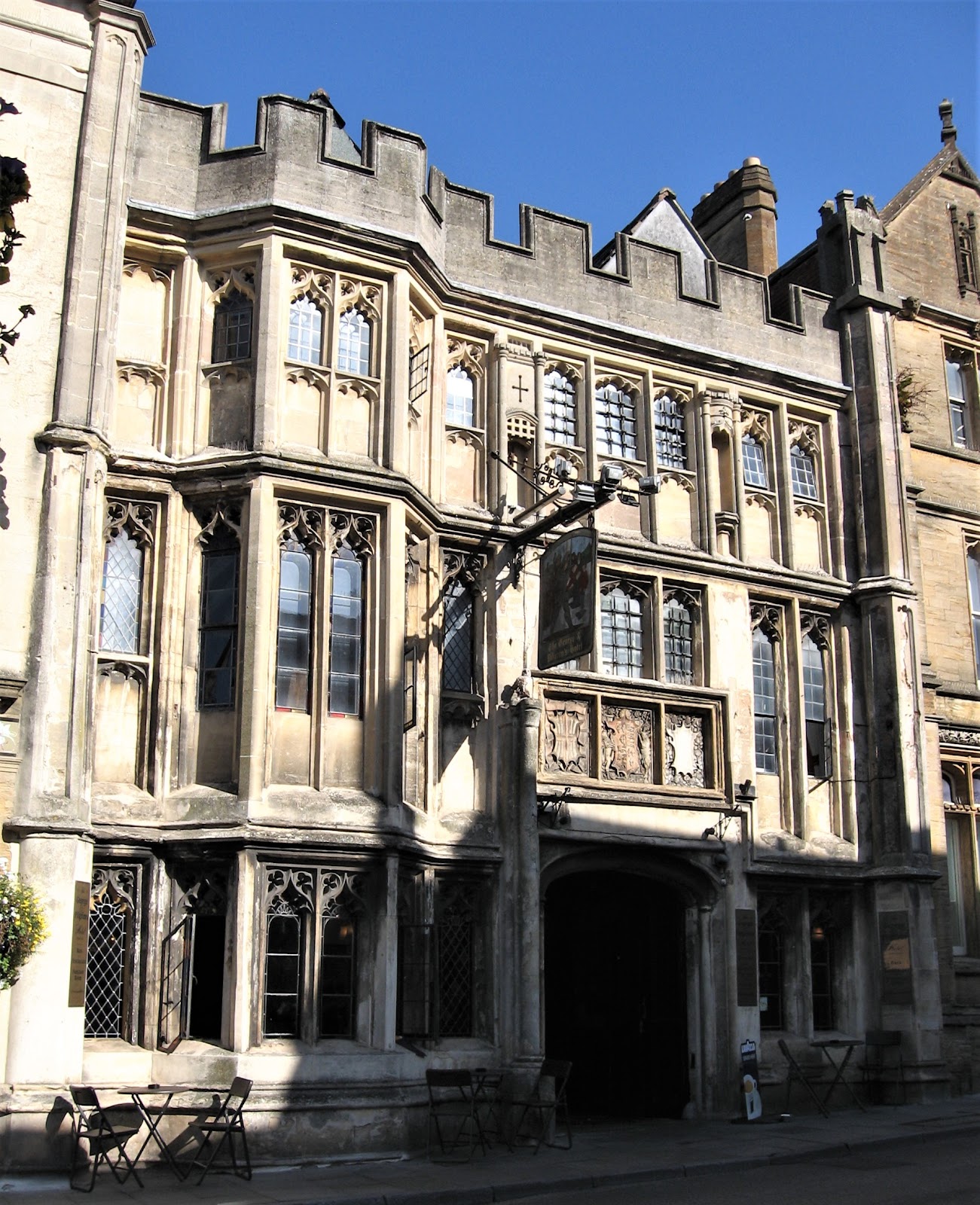
George and Pilgrim Hotel.
Photo by Diana Heins 19 September 2019
.

The George and Pilgrim Hotel was built in 1479.  The entry is through an archway to an alley with bar, restaurant to the left and reception and narrow circular stairs to the right.  It smells of old wet towels.  Room 10 has bathroom which is part of the hall to the fire stairs.  The floorboards squeak.  We phoned Hassel and spoke briefly to Serena explaining we had arrived in Glastonbury. We had dinner in the hotel restaurant.  It was very warm at night; Terry propped open the window with a wooden prop.


Glastonbury air photo showing location of 50 High Street (red pin) and Glastonbury Abbey.
Photo by Diana Heins, 20 September 2019


High Street, Glastonbury
Photo by Diana Heins, 20 September 2019

In the 1851 Census, Henry Goodfellow aged 27 and his wife Grace (Fitzpatrick), a school mistress aged 27, were living at 50 High Street Glastonbury with three children, George aged three years, Elizabeth aged one year and baby Arthur aged one month were all born in Glastonbury. 

Henry's birthplace was Wincanton.  Grace was a British subject born in France.  Also living with them were a school governess and a house servant.


Fabric shop, Glastonbury
Photo by Diana Heins, 20 September 2019

Thursday 19 September 2019. 

In the morning we were woken by the sound of barrels rolling down steps.  After breakfast, we walked back through Market Square to Northland Street and round the back to discover the Gauntlet alleyway, then up High Street to the Post Office next to the Wool Shop.  Opposite this fabric shop is number 50 High Street, where Henry and Grace were living in 1851.  This location is now the Avalon Club, built in 1897.

Friday, 20 September. Glastonbury

 After a late breakfast, we walked up High Street again taking photos of the old Tribunal building.  I talked to the owner of the Wool Shop, which had been a barber shop.  She didn’t know of any Goodfellow druggist business.  The Post Office next door was more recent; the man at the Information Centre told us 1900s; the plaque was 1938.  The previous post office had been up High Street and in the street to the right.  I took photos of High Street from both sides.  We walked back to the Information Centre which opened at 10am.  They gave us maps of the town and I told them about the Goodfellow family in the 1851 Census.

St John's Anglican Church, High Street, Glastonbury.
 Photograph by Diana Heins 19 September 2019.

Glastonbury has a product to sell.  Along High Street are many shops catering for alternative, mystical, crystals, elaborate long dresses, books on magic mushrooms and magic generally and much about the mythical King Arthur seem to predominate.  Being there on the eve of the Autumn Equinox may have increased the numbers of gongs, drums and bodhrans.

The previous day we had been disappointed to find the Church is being renovated so we just took photos from outside and walked back to the Town Hall to wait for the bus to Wincanton.


Photo by Diana Heins, 20 September 2019

We bought tickets for the bus up to Glastonbury Tor which left at 11am.  It was a steep and winding road so we were glad we had not walked.  There was still a steep path with many steps to the top of the Tor with its 15th century tower.  It was very windy but a wonderful view of the surrounding countryside.  Amazing to realise this Tor was an island with the flooded Somerset Levels all around.  There were people sunbaking, one man playing a huge gong.  We took photos towards Glastonbury and Street.  Down the hill we sent a birthday text message to Greg.


Glastonbury town from the Tor. 19 September 2019. Photograph by Diana Heins


Glastonbury Abbey ruins Photo by Diana Heins, 20 September 2019

Back on the bus to the town at midday, we walked to the park next to the playground east of the Abbey.  There were squirrels running across the grass and up the trees.  We returned to the Abbey where we spent a long time surveying the ruins, wondering where we took slide photos in 1971.  There was a herb garden, a deep pond, which had been part of the Abbey water supply and the old abbey kitchen on a very warm sunny afternoon.  


Fitzpatrick Evidence 1747 - 1847